
Training on Event-Based Surveillance (EBS) and Electronic Public Health Emergency Management (eBHEM) Convenes
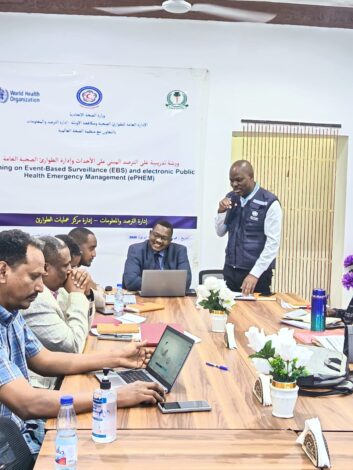
Training on event -based Surveillance (EBS) and Electronic Public Health Emergency Management (eBHEM) was launched this morning at Elegant Hall in Omdurman. The workshop is organized by the Surveillance and Information Department under the General Directorate of Health Emergencies and Epidemic Control, in collaboration with the World Health Organization (WHO).
It brings together representatives from various ministry departments, with the participation of a delegation from WHO’s Eastern Mediterranean Regional Office, and will continue until Wednesday, April 29, 2026.
After welcoming the WHO delegation from both the regional office and Sudan office, the Acting Director of the General Directorate of Health Emergencies and Epidemic Control, Dr. Al-Fadil Mohammed Mahmoud, expressed appreciation for the organization’s continued cooperation and support, particularly in building the capacities of ministry staff in general and emergency teams in particular.
Mahmoud emphasized that the workshop will enhance the capacities of participating staff in the Event-Based Surveillance system, which is one of the disease surveillance and information systems within emergency and epidemic control. It will strengthen their ability to detect events, investigate them, and respond rapidly.
Dr. Matawa Lubogo /WHO , highlighted the importance of the workshop in strengthening the health system’s capacity. He stressed the need to implement the Event-Based Surveillance (EBS) program in all its components, with particular focus on community-based surveillance, as it is a key pillar for early detection of health risks.
He also underscored the importance of implementing the Public Health Emergency Management program, alongside activating the Epidemic Intelligence from Open Sources (EIOS) system, due to their crucial role in supporting evidence-based decision-making.
Lubogo reaffirmed WHO’s commitment to continue its support through additional training courses at the state and locality levels, aimed at strengthening health system preparedness, ensuring rapid access to health information, and achieving effective and timely responses to various public health emergencies.
Meanwhile, the Director of the Emergency Operations Center, Fadl Al-Mawla Makawi, stated that the workshop comes at a time that requires improving the efficiency of personnel and strengthening disease surveillance, describing it as the “sensing horns” in the field that drive the health system forward.