
Expert Cameron Hudson Speaks out
Follow ups – The Citizen
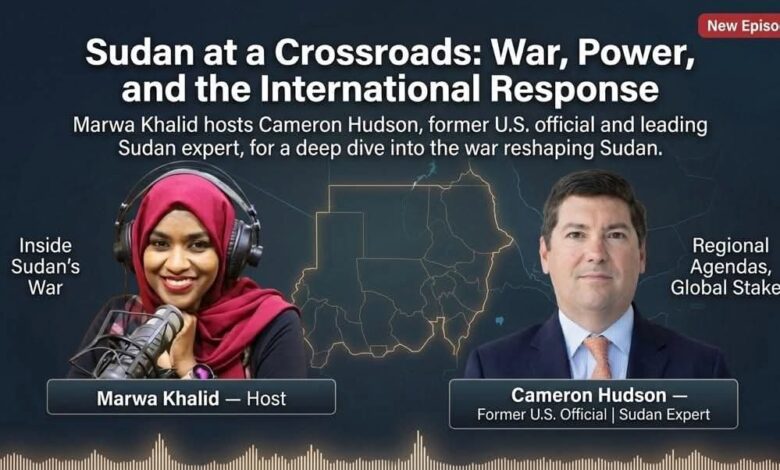
In a recent episode of Marwa Khalid Podcast hosted American researcher Cameron Hudson, who is one of the foremost experts on Sudan and the Horn of Africa.
Hudson responded to several critical questions on Sudan’s war.
For the benefit of our readers we hereunder publish summary of part from the said episode:
Hudson previously served as Director for African Affairs at the U.S. National Security Council in the White House and as Special Advisor for Sudan at the U.S. State Department. He is currently a researcher in the Africa Program at the Center for Strategic and International Studies (CSIS) in Washington, D.C., and is considered one of the researchers who have closely followed developments in Sudan for many years.
* Cameron Hudson: Treating the warring parties in Sudan as equals undermines the international community’s credibility.
* With the continued presence of the Rapid Support Forces militia, it becomes difficult to envision a future where Sudan lives in peace with itself.
Q: After all the documented atrocities of this war, is it fair for the international community to continue treating both sides as equally responsible?
Hudson clearly states that it is not. But he explains why from a diplomatic perspective. In his view, treating both sides as equals often reflects a kind of political laziness on the part of the international community, but it is also linked to the way international diplomacy operates.
Hudson says he understands why diplomats resort to this approach, as it is diplomatic practice itself. In many cases, diplomats try to maintain an image of neutrality so they can play the role of mediator between the warring parties. Declaring allegiance to a particular side can make it difficult for anyone to be accepted as a mediator in the conflict.
For this reason, he believes that many international diplomats try to maintain this balance in their rhetoric, even though public opinion, especially in Sudan, clearly sees what is happening on the ground and tries to read between the lines of this diplomatic language.
However, Hudson adds that this approach hasn’t necessarily been successful. In his view, continuing this seemingly balanced discourse has eroded the international community’s credibility, especially given the crimes committed during this war.
The discussion then shifts to the issue of sanctions. Marwa Khalid points out that some sanctions have already been imposed, such as those against Abdel Rahim Dagalo, the second-in-command of the Rapid Support Forces (RSF), in addition to the Interpol notices issued in this context.
But Hudson raises an important point. Despite these measures, no sanctions have been imposed on the RSF as an entity. The sanctions issued so far have targeted specific individuals for specific actions, whether by the United States, European countries, or through other international mechanisms.
He emphasizes that there is a significant difference between sanctioning individuals within a movement and targeting the armed movement itself. To date, there are no comprehensive sanctions against the RSF, no designation of it as a terrorist organization, and no international measures addressing its existence as an armed movement.
Hudson believes this may be the real transformation yet to occur. Imposing individual sanctions means the international community condemns the actions of certain individuals, but it doesn’t question the nature of the armed movement itself.
The next step, in his view, is to ask a deeper question: Can the Rapid Support Forces (RSF) even continue to exist as an armed movement in Sudan?
Hudson concludes this point with a stark warning: If this question isn’t seriously addressed, and if the very existence of this armed movement isn’t tackled, envisioning a future where Sudan lives in peace will remain extremely difficult.