
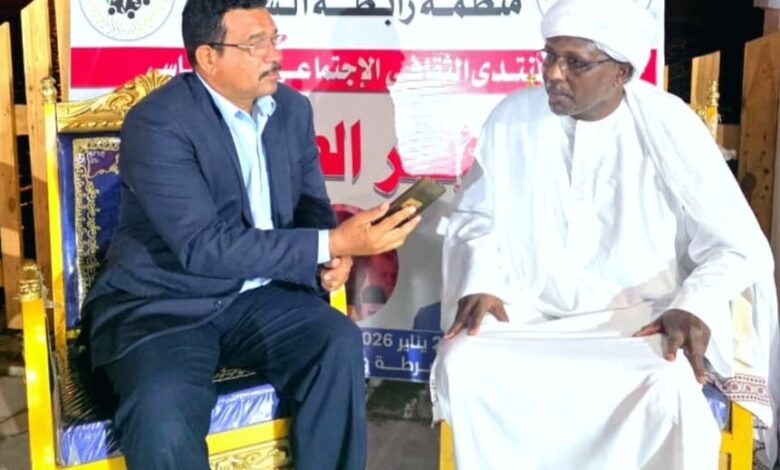
Sudan’s Ambassador to Ankara, Dr. Nader Al-Tayeb, in his interview with Citizen:
* Turkey’s position on the Sudanese war supports legitimacy, represented by the armed forces, and its support for the war of dignity.
* Turkey desires to achieve lasting peace in Sudan and is working to involve and consult Sudan in all steps toward achieving peace.
* There is coordination between Sudan and Turkey to spare the region conflict and tension and to maintain the security and safety of the Red Sea.
Introduction
In times of great challenges, the true mettle of friendships is revealed. At the heart of the crisis Sudan is experiencing, the features of an exceptional relationship with Turkey stand out—a relationship not measured solely by the volume of trade but also by the depth of humanitarian support and the steadfastness of the aid provided. Our interview today with His Excellency the Sudanese Ambassador to Turkey, Dr. Nader Youssef Al-Tayeb, offers a window into a complex landscape, allowing us to see how pain can be transformed into hope and how strategic partnerships can be a lifeline and a path to revival. Together, we will explore how a helping hand can heal wounds and how diplomats’ visions can be transformed into tangible realities that rebuild nations and sow the seeds of the future in conflict-ridden lands. Citizen met with Dr. Nader Youssef Al-Tayeb, the Sudanese Ambassador to Ankara, and conducted this interview with him.
Interview by: Mohamed Babiker
Q: What is Turkey’s official position on the ongoing conflict in Sudan since its beginning?
A: Turkey’s position has remained consistent since the beginning of the rebellion. It has affirmed its support for legitimacy, represented by the Sudanese Armed Forces, and its rejection of targeting the Armed Forces and attempts to destabilize and divide the country. Turkey has also affirmed its commitment to the unity and stability of Sudan.
Q: How can Turkey, as a regional and international power, contribute to achieving peace in Sudan, and what role is expected of it in the post-conflict phase?
A: Turkey is a pivotal and influential country regionally and internationally. It seeks, in cooperation with regional and international powers, to achieve a sustainable and just peace in Sudan. It emphasizes the necessity of involving and consulting the Sudanese government in all steps toward achieving peace and is expected to play a prominent role in the reconstruction phase.
Q: Are there similarities between the security challenges faced by Sudan and Turkey, and how can Turkey’s experience in combating terrorism offer a model for Sudan?
A: Yes, there is an important point to consider. Both countries face terrorist movements that target civilians and infrastructure, commit war crimes, and are supported by external actors. Last year, under the banner of a “Turkey Free of Terrorism,” Turkey successfully persuaded the Kurdistan Workers’ Party (PKK) to lay down its arms, disband its military wing, and engage in negotiations. Sudan, on the other hand, faces a terrorist militia that practices ethnic cleansing and genocide. The only solution is for them to lay down their arms, disband their military wing, and then engage in negotiations.
Q: What is the strategic importance of the Red Sea corridor for Turkey, and what is required of both countries to ensure the security and stability of this vital region?
A: The Red Sea corridor is a vital artery for trade and navigation in the region. It is important and strategic for Turkey, which uses the corridor for trade with the region. This necessitates cooperation and coordination between the two countries to prevent conflict and tension in the region and to maintain the security and safety of the Red Sea.
Q: Did Turkey provide humanitarian aid to Sudan during the recent crisis? What were the most prominent forms and extent of this support?
A: Yes, Turkey was quick to provide humanitarian assistance. In May 2023, it sent 60 tons of life-saving medicines in response to an appeal from the Ministry of Health. After the treacherous attack on Port Sudan, it sent firefighting equipment and supplies to extinguish the fire. The total amount of aid sent by sea is estimated at approximately 12,000 tons of food, shelter, and medical supplies. Around twenty Turkish voluntary organizations continued to provide direct support to displaced persons. The Turkish Cooperation and Coordination Agency (TIKA) implemented 16 projects in 2025, including the maintenance of health centers and the provision of medical equipment. Currently, the focus is on supporting the rehabilitation of the health and education services sector. One organization has committed to maintaining the Nilein Mosque, and another to building a secondary school.
Q: What are the future prospects for the volume of trade and investment between Sudan and Turkey, and what are the promising sectors that can be focused on?
A: We aspire to increase the volume of trade exchange to exceed one billion dollars and to boost Turkish investments in the agricultural, agro-processing, mining, renewable energy, and electricity sectors, as well as reconstruction. This is achievable, as the country has witnessed a remarkable influx of Turkish businesspeople recently, and there is a growing demand for Sudanese products, particularly cotton, sesame, and leather.
Q: What advice do you offer to Turkish businesspeople interested in investing in Sudan at this time, and what facilities are available to them?
A: My advice to Turkish businesspeople is to focus heavily on Sudan at this stage, as there are golden opportunities that may not be repeated. They are welcomed by both the public and the government, and His Excellency Head of the Sovereignty Council has graciously directed that they be granted entry visas to Sudan upon arrival. We are also working towards obtaining reciprocal visa exemptions from the Turkish side.
Q: What role do Sudanese students in Türkiye play in strengthening relations between the two countries on various levels?
A: Turkey has been keen to provide scholarships to Sudanese students since the 1990s and has welcomed those who wish to study at their own expense. The number of students in Turkish universities is estimated at about 5,300 in various disciplines and to obtain various academic degrees. They represent a vital bridge of communication between the two peoples and provide a model of high behavior and good morals. They represent a nucleus for supporting communication and economic, commercial and cultural cooperation between the two peoples, as Turkish companies focus on using them in managing their investments in the country. The students also play a pioneering role in introducing the history, heritage and culture of our people in all Turkish cities.
Q: How many members are in the Sudanese community in Turkey, what is their situation, what are their main activities, and what role does the embassy play in supporting them, especially after the war?
A: The Sudanese community in Turkey is estimated at around 12,000, according to Turkish authorities. They are concentrated in Istanbul, Ankara, Konya, and several other cities. They enjoy a good reputation and are welcomed and respected by the Turkish people. They have formed associations and organizations to serve their members and are keen to celebrate national and religious holidays and engage with events in Sudan. The General Union of Sudanese Students, in cooperation with Turkish organizations, organized demonstrations in 12 Turkish cities to condemn the crimes of the terrorist militia. The embassy has been working to resolve the situation of Sudanese stranded in Turkey after the war and has succeeded in obtaining humanitarian residency permits for a large number of them. It is also following up with Turkish authorities to address the situations of the remaining individuals.
Q: What are the most important recommendations that emerged from the symposium “Turkey and Sudan: Strategic Relations,” organized by the Peoples’ League Organization in Port Sudan to strengthen and activate cooperation mechanisms between Sudan and Turkey?
A: Perhaps the most important recommendations of the symposium are to work on reconstituting the mechanisms of cooperation, especially the joint business council from the Sudanese side and the friendship associations, as well as forming a follow-up committee from the association to follow up on the implementation of the symposium’s outcomes, and setting a timetable for implementing the recommendations. We will strive, in coordination with the Turkish embassy, to implement the recommendations.