
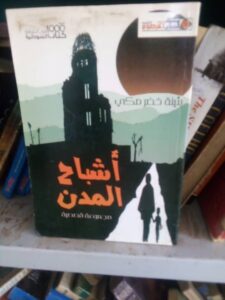
Ghosts of the Cities
By: Buthaina Khider
He turned his head to the right, captivated by the beauty of the waves, gazing at their flow with eyes filled with admiration and tenderness. The fresh scent of silt mingled in his nose with the fragrance of ancient sycamore, ficus, and mahogany trees, blending with the aroma of banana plants and fresh vegetables. The towering trees, centuries old, intertwined intimately along both sides of the road, forming a dense canopy that blocked the weary sunlight, allowing only scattered circles, rectangles, and irregular shapes to seep through to the ground.
The sweetness of the moment was shattered by the blaring car horns behind him (*honk… beep… beep…*). He straightened in his seat, pressing slightly on the accelerator as he sighed wistfully, longing to embrace those warm waves to his chest, to cradle them as the banks of the Nile cradled its waters.
Nourein was a twin, but his brother had spent his childhood disabled after contracting meningitis in his early months, turning his treatment into a heavy burden for the family—one he had no choice but to help carry. When he turned eight, his mother took him to Al-Fashir to work as a servant in the home of a wealthy merchant. Her eyes would gleam with something akin to satisfaction whenever he returned at the end of the month with a meager sum that helped her care for his sick sibling and his four younger sisters. He spent Thursdays and Fridays with his family, where his sisters would welcome him with overwhelming joy, while he watched his mother—her body growing thinner after his father’s death—with heavy eyes. He wished she would embrace him just once, like the lady he served did with her own children, but it felt impossible. His mother seemed more tense and exhausted each time, as if his touch might stop her weary heart from beating altogether.
The car horns assaulted him again (*beep… honk…*), so he raised his hand in apology as he turned left. He was just past nineteen—a young man of strong build, dark-skinned to the point of blackness, but his smile, revealing gleaming white teeth, gave his face a unique radiance. His wide eyes sparkled even brighter when he smiled, exuding a kindness tinged with hidden sorrow.
His employer’s family liked him greatly and treated him with respect, never distinguishing between him and their own children. Yet, he still ate alone and slept in a small, isolated room in the courtyard of the grand house. That beautiful house, crowned with a satellite dish, where air conditioners hummed ceaselessly. And when the power cut out, he’d hear his name called from the upper windows to start the large generator, as Hajj Radwan had taught him. The house would light up, the sounds of televisions and music rising, while he remained in his dark room, opening his small window in hopes that remnants of light might slip through the garden trees.
He always consoled himself that, no matter his social standing, in the eyes of his village, he lived in Khartoum—the capital. He had started as a houseboy, sweeping floors and washing dishes, then accompanied the Hajj to the wholesale market before working as an assistant on a truck delivering goods to retailers. When the family moved to Khartoum after building their lavish home in Al-Manshiya, he went with them, later becoming their private driver. He drove the children to school and the Hajj to the Arab Market, then returned to take Raja—the family’s only daughter, who was his age—to university.
Every day, he waited for her outside the university until one in the afternoon. She would emerge with loud chatter and laughter, ordering him in a spoiled tone to drop off her siblings before carrying the “lunchbox” to her father and staying by his side until Maghrib.
But that day, Raja was late. Anxiety crept into his heart as he glanced at his watch repeatedly, scanning the young faces in hopes of spotting her. He began imagining the children alone in the schoolyard after everyone had left, the Hajj scolding him angrily, his mustache quivering with rage, and the lady receiving news of her children’s kidnapping—all because of him. He muttered to himself in frustration:
*”Why doesn’t Raja come out now and spare me these tormenting thoughts? Damn this crowded, suspicious city!
He slammed the car door irritably, pocketed the keys, and let his feet carry him unconsciously into the university grounds. One of the girls laughed when he asked for “Raja Radwan,” then questioned which faculty she was in—he had no answer. He wandered through the crowds, his heart pounding like a frightened rabbit.
Then, suddenly, he spotted her. She was sitting on a wooden bench under the shade of a massive tree, next to a well-dressed young man who seemed slightly older. They were talking and laughing freely, and he watched them for a long time—until the young man reached out to place a casual, affectionate hand on Raja’s shoulder. At that, Nourein pounced like a leopard, shoving the young man away as he shouted furiously: “Say goodbye from a distance and don’t touch her—she’s not your sister!”
The young man froze in shock, while Raja quickly grasped the situation. She let out a sharp laugh, saying to her friend with biting sarcasm: Ignore him… He’s the driver. Suffers from a bit of a mental delay!
Then she deliberately met Nourein’s gaze as she hugged her friend warmly.
The entire ride back, her words rang in his ears like shards of scorching iron. Painful images flooded his mind: his sick twin brother, his exhausted mother who had never given him warmth, and Raja embracing that young man to humiliate him. He let out a burning sigh, wishing for a place to rest his heavy head—somewhere between the arms of warm waves that would cradle him.
That evening, Raja was furious, threatening to have him thrown out if he ever repeated his actions. Her words were cutting, arrogant—but he didn’t dare utter a single word in response.
That night, he drove Hajj Radwan to a friend’s house in Shambat for a condolence visit. He waited briefly until the old man entered, then quietly started the engine. This time, he drove with reckless speed toward the bridge, a cryptic smile on his face as he crashed into the iron barrier. The sound of impact roared—and the last thing he felt was the embrace of the warm waves…
P S: ” Ghosts of the Cities” appeared first as one of 100 books on Sudanese Culture , a project implemented by Khartoum Authority for Press & Publishing. Selected and translated by Abdulaziz Ali Omer. .