
Gezira Scheme Governor: Summer Season’s Success Led to Lower Agricultural Prices in Markets
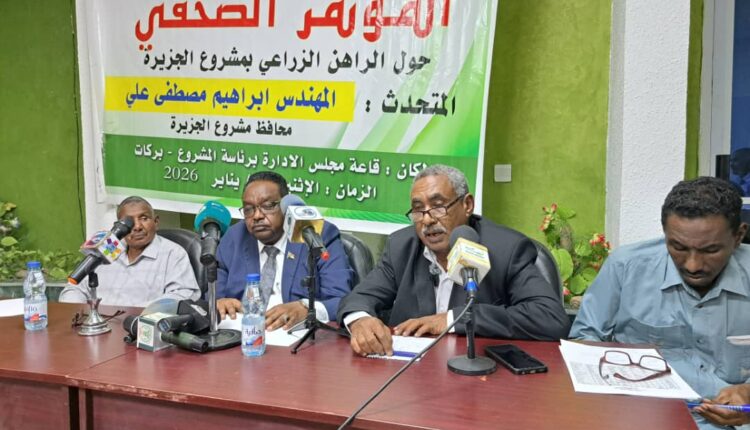
Engineer Ibrahim Mustafa, Governor of the Gezira Scheme, stated at a press conference organized by the project’s administration that the success of the summer season in the project led to a decrease in crop prices in the state’s markets and neighboring states.
He pointed out that the previous summer agricultural season was a challenging one, as the project, like others, was subjected to systematic sabotage. He said that the project lost all its agricultural machinery and equipment.
He praised the efforts of the Sovereignty Council, the Council of Ministers, the Gezira State government, and humanitarian aid organizations in providing support for the summer season. Approximately 850,000 feddans were cultivated, and a number of machines were purchased, contributing to the season’s success.
He added that the Gezira Scheme aims to cultivate more than 250,000 acres of wheat during the current winter season.
He noted the reluctance of farmers to cultivate wheat, attributing this to the high costs of production inputs.
He revealed the Gezira Scheme management’s plan to secure financing for the season through the project’s administration, according to specific criteria.
He emphasized that wheat is now considered a staple and strategic food crop and requires support from the federal government.
He stressed that financing is one of the biggest challenges facing farmers.
Regarding irrigation, the project’s governor explained that the project management had assumed control of irrigation within the Gezira Scheme to reduce administrative overhead. He emphasized the project’s capacity to manage irrigation within its boundaries, noting the integration of 1,200 engineers and technicians from the Ministry of Irrigation, along with the provision of 118 pieces of equipment to operate across the project’s 21 sections.
He announced the completion of dredging operations in 485 canals and 39 main irrigation ditches, representing approximately 85% of the project’s area.
He pointed to the Gezira Scheme’s six-year experience in managing irrigation, which has yielded significant successes.
Engineer Ibrahim Mustafa also revealed a comprehensive plan to reform the project, based on the enforcement of good governance. This plan aims to define the relationship between the project management and farmers, the relationship between the state and landholdings, and to address encroachments on project property.
He stated that the governance procedures are 80% complete and disclosed the state’s intention to appoint a commissioner for the Gezira Scheme to enforce laws and recover project assets. He emphasized that not a single meter of project land has been relinquished.
He added that the plan includes bringing in specialized gravity irrigation companies after the completion of technical studies for the main canals.
He affirmed that the project management is striving to increase cultivated areas and maximize the utilization of the Gezira Scheme’s quota of 6 million cubic meters, of which approximately 2 million cubic meters are currently being used.
He further noted that the plan focuses on crop rotation and incorporating livestock into the agricultural cycle.
For his part, Engineer Mohamed Osman Al-Awad, Director of the Irrigation Unit at the Gezira Scheme, explained that the irrigation department removed 890,000 cubic meters of silt over two months, in addition to clearing 2,255 kilograms of weeds.
Engineer Ali Ahmed Ibrahim, Director of the Agricultural Administration for the project, praised the efforts of farmers in the Al-Manaqil districts during the occupation of Gezira State by the Rapid Support Forces (RSF) militias. He noted that significant areas in Al-Manaqil were cultivated, contributing to the availability of seeds for the previous season.