
Khartoum Governor calls for a focus on production and prioritizing reconstruction based on workshop and conference outcomes
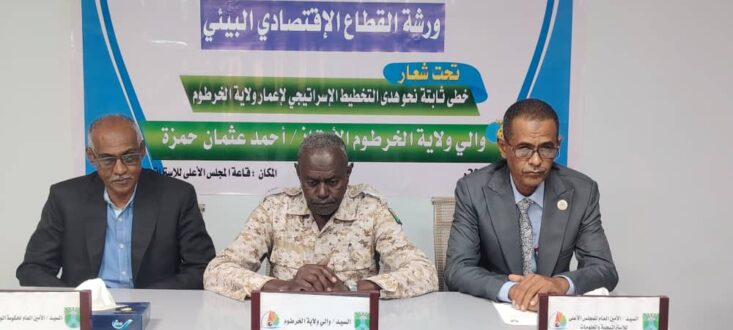
The Governor of Khartoum, Ahmed Osman Hamza, affirmed that the Sudanese people are capable of presenting a model to the world in recovery and reconstruction, despite the systematic destruction of infrastructure and industrial and productive sectors. He stated that Sudan possesses strategic minds and vast underground and surface resources, which form the basis for a new beginning.
The Governor explained that these assets motivated the approval of the Khartoum State Strategic Vision 2026-2036. This vision aims to double production, develop economic and service sectors, and enhance the role of culture and media, alongside other vital sectors that will support the reconstruction process, increase investment, and utilize resources for the benefit of the citizens.
This came during his address this morning to the opening session of the sectoral workshops for preparing the ten-year strategic plan for Khartoum State, under the slogan: “Steadfast Steps Towards Strategic Planning for the Reconstruction of Khartoum State.”
The workshop was held at the Supreme Council for Strategy and Information Hall in Khartoum, in the presence of the Secretary-General of the State Government, Al-Hadi Abdel-Sayed Ibrahim, the Secretary-General of the Council, Dr. Essam Batran, members of the State Government, and a number of experts and specialists in the field of strategic planning.
The Governor called on the participants to analyze the problems and obstacles facing the executive branch and to develop strategic visions that contribute to establishing security and enforcing the authority of the state.
He also stressed the importance of benefiting from previous studies and workshops, most notably the Reconstruction Workshop and the Khartoum State Development Conference, in order to produce clear recommendations that focus on production as one of the strategic solutions to the problems facing the state and define reconstruction priorities and the equitable distribution of services between rural and urban areas.
The Governor emphasized the need to give the education, health, industry, social, and cultural sectors the necessary attention within the plan, pledging to implement the workshops’ outcomes and translate them into tangible projects on the ground. He pointed out the importance of involving citizens through neighborhood committees, producers, and stakeholders in preparing the ten-year plan. The Secretary-General of the State Government, Al-Hadi Abdel-Sayed Ibrahim, affirmed that the sectoral workshops represent a crucial step in establishing a scientific foundation for the ten-year plan. He explained that the State Government was keen to involve all relevant institutions and stakeholders to ensure a realistic plan that responds to citizens’ needs and aligns with the requirements of the current phase.
He noted that the General Secretariat provided a supportive environment for the workshops’ success, contributing to the production of accurate outputs that will improve executive performance in the coming years.
For his part, the Secretary-General of the Council, Dr. Essam Batran, explained that the current workshops are working on developing comprehensive strategic plans for the (socio-cultural-political – governance, administration, security, and justice – strategic, information, and digital transformation – economic) sectors, with broad participation from thinkers, planners, university professors, and experts.
Batran indicated that the workshops aim to usher in a new era of national recovery and reconstruction through a strategic plan designed to mitigate the effects of war and rebuild damaged infrastructure. He emphasized that the workshop is working on planning a new reality for Khartoum State based on a scientific approach that directs resources towards essential service issues affecting people’s livelihoods, in addition to focusing on priorities that promote community growth and support reconstruction plans in the next phase.