
UN reveals deployment of South Sudanese police and Rapid Support Forces in Abyei
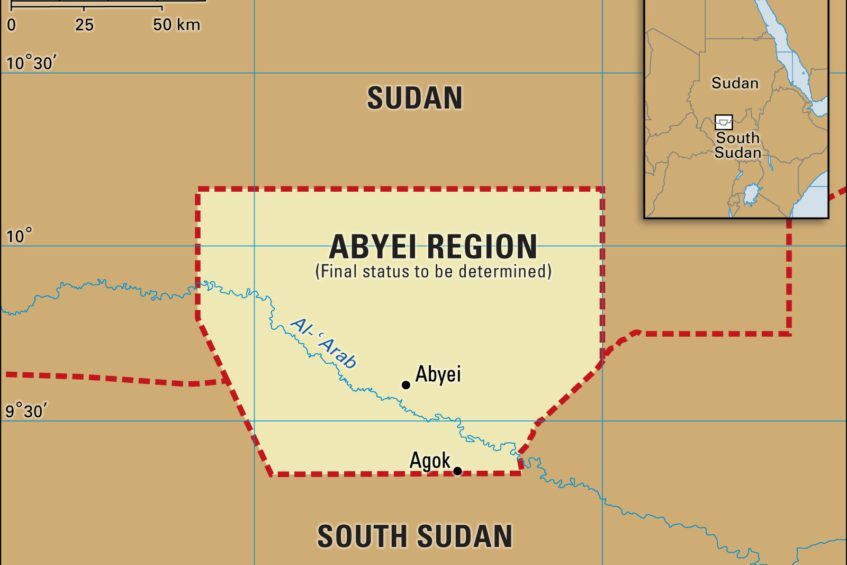
UN Secretary-General António Guterres revealed an increased deployment of South Sudanese security forces and Rapid Support Forces in Abyei area, whose sovereignty is disputed between Khartoum and Juba.
This deployment constitutes a violation of an agreement signed by the Sudanese government and the Sudan People’s Liberation Movement in 2011 regarding temporary arrangements for the administration and security of Abyei.
In early May, Guterres submitted a report to the UN Security Council on the implementation of the mandate of the United Nations Interim Security Force in Abyei (UNISFA), covering the period from October 2, 2024, to April 15, 2025. The report, on Tuesday, stated: “South Sudanese security forces, comprising at least 600 soldiers and police personnel, remained deployed in southern Abyei in violation of the 2011 agreement.”
He noted that this number represents an increase from the previous period covered by the previous report, as UNISFA sent two notes verbales to the Government of South Sudan protesting the presence of security forces in Abyei.
He explained that the mission leadership reiterated the need to withdraw security forces during meetings with South Sudanese authorities in December 2024 and February and March 2025.
He revealed that the Popular Defense Forces (SPLA) – the South Sudan army – had established positions in the Agok area and set up checkpoints at the Atony and Koryuch intersections, and had occupied civilian buildings, including three schools and the Agok Protection Committee center.
He confirmed that the army and police occupation of the Agok Protection Committee facilities hindered the ability of UN police to share the site with the Protection Committee and provide guidance and support, and also affected the rights of civilians to access education, livelihoods, and health care.
The report indicated that the presence of security forces in southern Abyei affects the ability of UNISFA to conducting patrols south of the Atony Junction and establishing an operations base.
He stated that the South Sudanese police had established a checkpoint in Panakwash, 12 kilometers north of the southernmost point of the Safe Demilitarized Border Zone, to impose restrictions on the movement of the Joint Border Monitoring Mechanism patrols, in violation of the Status of Forces Agreement.
He explained that South Sudanese security forces were deployed in Phenikang and Kobri, in violation of the demilitarized nature of the Safe Border Zone. The report indicated that the flow of small arms and light weapons continued into northern Abyei, and there were reports indicating the presence of individuals associated with the Rapid Support Forces in the Amiet Market. He explained that on March 12, the Interim Security Force intercepted a person wearing a Rapid Support Forces uniform near its base in Diffra. That same day, two individuals claiming to be the commander and deputy commander in charge of the Rapid Support Forces in Diffra, along with a group of protesters, gathered to demand the release of the arrested person, who was later released.
It was reported that on March 13, an Interim Security Force patrol saw approximately 25 regular personnel and Rapid Support Forces soldiers near the village of Mekinis in the northern sector, who were said to be investigating a robbery. The report stated that the Interim Security Force held meetings on March 23 and 24 with the Government of South Sudan to discuss the threat posed by the Rapid Support Forces to the freedom of movement of the force’s personnel.
On February 28, the Rapid Support Forces launched an attack on an Interim Security Force logistics convoy in the Nyama area of West Kordofan State, which was en route from Abyei to Abyei Joint Oversight Committee headquarters in Kadugli, South Darfur. During the attack, the Rapid Support Forces kidnapped four peacekeepers and eight drivers, confiscated UN equipment, and released the soldiers without returning eight fuel trucks they had confiscated during the attack.
The report stated that the conflict in Sudan prevented private contractors from resupplying AJOC headquarters in Kadugli, necessitating the Logistics convoys escorted by peacekeepers.
He said that these convoys encounter various Rapid Support Forces checkpoints along the way, posing a threat to their security. The UN Secretary-General explained that the political process in Abyei remained affected by the conflict in Sudan and internal challenges in South Sudan, without any progress on resolving the final status of the area and border issues.
He noted that the Government of South Sudan held the eighth Governors’ Forum in Juba from November 26 to December 2, 2024, where it recommended the operationalization of Khadyan “Atony” Airport and the deployment of police to Abyei.