
Book Review (Kosti)
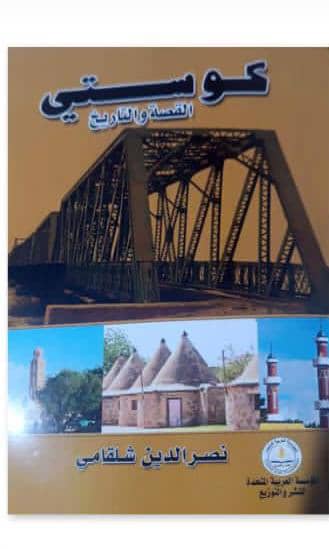
Reviewed by Tahir Al-Mutasim
Summary:
The launch of the book (Kosti: The Story and the History)
The writer was amog others in the inauguration forum of the second edition of the book (Kosti) by Dr. Nasreldin Shulgami, at the Goethe-Institut in Cairo, with qualitative presence.
The forum was moderated by the Influential media expert Tasneem Rabeh.
The 314 pages of the book are divided into four chapters, with pictures, maps references.
The history of Kosti City:
The book presents a historical extrapolation of Kosti throughout the ages to modern Kosti.
It says that the city’s name belongs to the Greek merchant Kosti Papis, who bought a plot of land in 1900, which makes it one of the most recent founding cities among the Sudanese cities.
The Development of Kosti and its Notable Events:
Kosti developed due to its strategic location on the White Nile and intersections a matter that makes it an important river port.
The book sheds light on the three main stages of it’s development, besides documenting important events such as Jodah Ward tragedy (1956) and Aba Island events (1970).
The Social and Cultural Aspects:
The book sheds light on the social and cultural life in Kosti, including the
literary and sports movement, besides the first emergence of Tumtum rhythm.
The book touched upon several prominent figures in the city e. g. Mohammad Kareem Abbass, Engineer Abdulla Shaddad and other who contributed in Sudan’s history.
The Book:
Less than a month ago, I was pleased to accept the invitation of the Goethe-Institut Sudan in Cairo to launch the second edition of “Kosti” by Dr. Nasreldin Shulgamy.
My relationship with the poetry of the German poet Goethe is long-standing.
My connection to the institute in Khartoum goes back years, and my friendship with Dr. Nasreldin Shulgamy is deep.
My affection for the city of Kosti is well-known. Therefore, I insisted on attending the launch, which was moderated by the accomplished journalist Tasneem Rabeh.
The audience was delighted by the star of “Igd Al-Jallad Band”, my friend Sharif Sharhabil, amidst a distinguished audience that filled the hall to the point of spilling over into the streets of Doggi district that evening in Cairo.
“Kosti,” which is
314 pages long, is in its second publication after nearly a quarter of a century.
It is an expansion of the author’s articles published in 1988 in the newspaper “Al-Siyasa,” may God restore it and protect its founder, Khaled Farah, and its staff.
The book is divided into four chapters, some writings about the city, references, photos, and maps.
Kosti
Story and History –
United Arab Emirates Science and Distribution
Nasreldin Shulgami
Characteristics of modern cities and a unique and cohesive social fabric.
The three phases that witnessed the city’s growth were the construction of the old Kosti Bridge, which facilitated trade flow to western Sudan.
The second phase was the transfer of the presidency of the River Transport Corporation to the city in 1951.
The 1970s saw the implementation of development projects within and near the city, such as the Kenana Sugar Factory, Asalaya Sugar Factory, and Rabak Cement Factory.
The book presents an investigation into important events and eyewitness testimony.
The first is the Jodah Award Events, about a month after Sudan’s independence, which claimed the lives of approximately 200 farmers.
The incident occurred as a result of exhaustion, heat, and lack of oxygen in their detention center. The second incident is the Aba Island events, in which the regime of Gaafar Nimeiri bombed Aba Island in March 1970.
The book documents the testimony of Abu al-Qasim Muhammad Ibrahim, a member of the Command Council of the May coup, and includes photographs of Jodah Award and of Gaafar Nimeiri entering the palace of Imam al-Hadi.
The author presents a historical survey of the city in ancient history, throughout the Greek and Roman eras, during the Christian era, during the Mahdist period, during the the Anglo-Egyptian Condominium, and during modern Kosti.
The book claims that the city’s name comes from the name of the Greek merchant Kosti Papis. It also includes the sale of a plot of land measuring 1,000 acres to the Greek merchant by Hamad Wad Umm Dodo in 1900, making it one of the most recently established cities in Sudan.
The fourth chapter of the book sheds light on spiritual aspects, education, the national movement, the literary movement, sports, and the beginnings of the Ta
Tum Tum rhythm, likening it to the rock ‘n’ roll craze of the first half of the last century in Europe and America.
The book points to the beginning of the Tum Tum rhythm in 1932 at the hands of Kosti Twins singers.
The chapters are concluded with a portrait of the rich social life in Kosti, including Mr. Muhammad Karim Abbas, the center’s inspector; Engineer Abdullah Shaddad; Chief Ahmed Mekki Abdo; Rashid Mirghani Hamza; and Muhammad Daoud Al-Khalifa.
Among those who worked there were Judge Abdul Aziz Shiddu, the late journalist Muhammad al-Hasan Ahmed, and number of prominent figures in Sudanese history.
Kosti’s location on the banks of the White Nile and its intersection made it one of the most important river ports at the beginning of the last century.
Although the authorities at the time called it “Al-Jadid” (the new name) and banned the name “Kosti,” the popular will adhered to the old name and dropped “Al-Jadid.”
The author points out that the city was not established on tribal or clan-based foundations that held on to the land. Rather, several tribal migrations flocked to it, in addition to foreigners and Arabs, including Greeks, Egyptians, and Levantines, to work in trade, especially after the railway reached the city in 1911.
I conclude that the book is a very important documentation of the city located in the heart of Sudan, and the momentous events that took place there and in its vicinity.
The book gains its importance in light of the devastating war that displaced millions, including generations over the course of two years of war who lost their connection and lost their memory of the spirit of Sudan, represented in its cities, villages, and social life.