
Al-Ameen Al-Haj: The Mandela of East Sudan

By: Abdul Aziz Ali Omer
For several years, my extended family would stop at Birinji and walk past the Gedaref Legislative Council to reach our destination : my uncle-Ameen Al-Hajj’s house. His home, was a safe and peaceful haven during our childhood summers, filled with with warmth and love. I vividly remember the portrait of a tearful child, a black-and-white family photo, and Aunt Nafisa’s youthful features that adorned the walls.
My grandmother, Setal, would insist that we should drink some tea, saying , “It’s just hot water.” In the cold mornings of Khartoum ,I also miss Aunt Madina who affectionately urged whoever went into her home , “Papa! Come on . Have some tea”. Al-meen Al-Hajj, the athlete, banker and politician through Beja Congress and Eastern Sudan Front championed the rights of East Sudan’s minorities . He didn”t only resemble Mandela of South Africa but he was similarly revered as the Mandela of East Sudan.
Eventually, the day came when Al-Amin Al-Hajj had passed away. Dr. Bashir Mohamed Tahir mourned him, stating, “He was an exceptional civil servant and a unique community figure.” His death was met with great sorrow. On his behalf, I sent emails to his colleagues from the East Sudan peace mediators before he left with the negotiating delegation to Asmara., the capital of Eriteria. There, I recall my uncle’s love for simple pleasures like porridge in Wazentat, which he said, he could still feel it’s taste on his tongue.
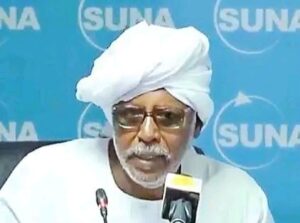
In 2009, I visited the suburbs of Gedaref for the first time to attend a UNDP workshop, accompanied by his private driver, Osman Abdullah , and his bodyguard, Abdel Moneim. Musa and with us AlAmeen AlHajj,Galla Nahal commissioner. Our trip was delayed until afternoon due to a ceremony welcoming the interior minister to Gedaref.
When we arrived at Galla Nahal locality buildings, we sat outside the old buildings, watching some historical relics and autumn clouds beautifully pyling on the misty horizon. Uncle Al-Ameen appreciated simple workers who had a sense of humor, including Al- Mardy who once joked about his ageing grief.
Uncle Al-Ameen had asked Mardy to add sesame oil to the vegetable salad, and shared a nice meal and laughter with his employees . The next day, at the convention hall, I was taking notes when an elder man in the audience asked, me “Are you a journalist, my son?”. My journey into journalism began in 2013, and It was my uncle who instilled in me the passion for story-telling.
We would occasionally meet in crowded places, he would greet me warmly, and re-assuring me with his smile . The last time I saw him was near the land registry department, where we discussed the diseases that were spreading at the time, such as high blood pressure. “But there are many things that can make one unhappy and increase the cases of fatal hypertention ,” I remarked. He smiled and said, “I suffer from numerous ailments, and if any illness could kill me, it would have done so by now. persons only die because of their days; otherwise, they just endure.”
Little did I know that he regretted my absence and lack of visits, sensing that our time together was short. His words echoed the poet Rawda Al-Hajj: “I’m tired, and what remains of my life isn’t enough for my wounds.”
Suddenly, he passed away from the epidemic of dengue fever and I had learnt of his death hours after rhe end of his funeral while I was signing a bail document to release my brother Salh from prison.
One autumn morning, he rang to ask for my assistance as a friend. He had an interview with Dr. John Young, an expert on Horn of Africa issues regarding the East Sudan crisis. John Young, formerly an editor at the Sudan Times and now a university lecturer in Addis Ababa, had conducted valuable research on the Tigray people struggle. I have a souvenir photo of the three of us: Uncle Al-Ameen, myself, and Dr. John Young at Setit hotel in Gedaref. . We entered a restaurant with a fourth individual representing the communist party, and he had to apologize for his absence for security reasons.
“Are you from Beja?” Dr. John asked in surprise. “Yes,” I replied. He responded, “For the first time, I’ve ever met someone from Beja who is very good at communication skills.” During translation, as I was about to describe Shotal” as a Yemeni-style dagger, my uncle interrupted to say “knife” in English, which Dr. John understood, having lived in Sudan since 1985.
The most challenging question concerned the food in the restaurant. I whispered to my uncle, who said, “Tell him it’s meat.” Dr. John replied, “I know it’s meat, but what is it called?” He didn’t pursue the topic further and shifted to other subjects.
In the aftermath of his passing, tcitizen I met Abdel Gadir Al-Himi from Deim Al-Noor , which Al-Amin Al-Hajj described as” a homogeneous mixture of tribes and ethnicities ” . From my initial meeting with him , I realized that Alameen “s legacy lives on was on through his friends and colleagues . Ala Hiimi shared me insights on the Ethiopian Renaissance Dam.
In the last conversation with him, ” Of course, I was there at the beginning of the war in Khartoum,” AlAmeen Al Haj said referring to the conflict that had erupted on April 15 between the Sudanese Armed Forces and the Rapid Support Militia. He added further , “I spent most of the war days there.”
Finally, I asked him as the poet Nazar Ghabani asked in ” Seven Messages lost in Beirut Mail” : “The war trampled the leaves of roses, the stalks of crops, scattering us. This wicked war made us ugly, distorted us, and burned all old files. Millions of things within us were eroded. The question is : “can humans forge deep love and intimacy?” Al-Amin Al-Hajj’s respnded with some optimism “Yes, one can.”
“It seems I’ve forgotten that misfortunes don’t come singly. I lost Uncle Yassin too. My uncles Yassin and Al-Ameen worked in two institutions that converged like the White Nile River and its blue twin, the Blue Nile – Gedaref Agricultural Bank and Gedaref Grain Silo.
I’ll never forget Uncle Yassin’s tears when our family gathered around after hearing rumors of his death. Regaining consciousness, we heard the sound of pain and love, but our brief happiness and joy was akin to someone who, after reaching the peak of despair and exhaustion in search of water, suddenly finds a spurting spring.
I never imagined that death would take them and depart with them to His home. .May God forgive thier sins , expand their graves, and make them gardens of Paradise. We say nothing but what pleases Allah. Indeed, we belong to Allah and to Him we shall return.